What to look at
Reading a harbour in ten minutes
Shelter, depth, services, town. In that order, and the fourth one is the one everybody judges a harbour by.
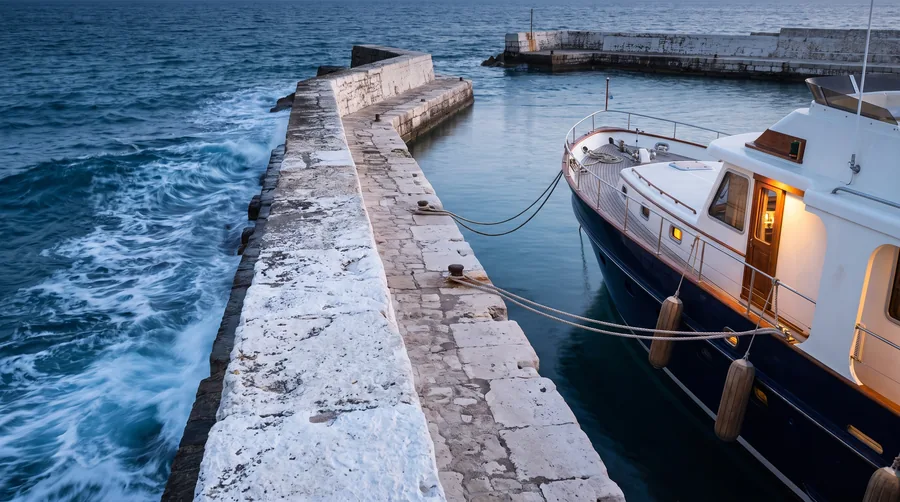
Stand on the quay of a harbour you are considering and you can learn most of what matters before the coffee arrives. Captains do this instinctively. Owners tend to look at the restaurants.
One: which way does the weather come from
Every coast has a wind that causes the trouble: the mistral in the Gulf of Lion, the meltemi in the Aegean, the bora in the Adriatic, the tramontana in the Balearics. The question is not whether the harbour is sheltered but whether it is sheltered from that one. A breakwater that faces the pretty view and leaves the entrance open to the north is a summer harbour, not a home.
Look at the mooring lines on the boats already there. Doubled up lines and heavy fenders on a calm day mean the locals know something.
Two: what is under the water
Charted depth at the quay is one number; depth in the approach at low water with a swell running is another. Ask the harbourmaster for the depth alongside the specific berth, not the marina average, and ask when it was last dredged. Silting is normal, dredging is political, and a marina that has not dredged in eight years has a berth that is no longer the depth on the plan.
Three: who can fix things
Within an hour of a good working harbour there is a chandler who stocks more than fenders, an electrician who has worked on yachts, a rigger, a refrigeration engineer, a shipyard with a travel lift and somebody who can get a part from Germany by Thursday. This is the difference between a harbour and a car park, and it does not show in any photograph.
- A fuel dock that takes a large yacht, with the hours posted and a realistic flow rate.
- Shore power at the amperage the fleet actually needs, not the amperage on the sign.
- A chandler and at least two marine trades within an hour.
- Water of drinkable quality, metered rather than rationed.
- A taxi rank, a supermarket that delivers and somewhere the crew can eat at eleven at night.
Four: the town
Last, and the one everybody starts with. A beautiful town is a genuine asset for guests and a genuine trap for owners, because the harbours attached to beautiful towns are usually old, shallow, exposed and short of services. The right answer for most boats is a working harbour within forty minutes of a beautiful town, which is the arrangement every experienced captain on the Riviera has quietly arrived at.
Ask the crew where they would keep the boat. They will name the ugly harbour with the good chandler every time.
A fleet manager, on how to choose a home portThe ten minute test
Use it now
Berth Calculator
What a berth costs by the night and by the season, in twenty four harbours.