Sail against motor
The case for canvas, made honestly
A sailing superyacht is cheaper to run, quieter, and harder in every other respect. Here is the argument with the inconvenient parts left in.
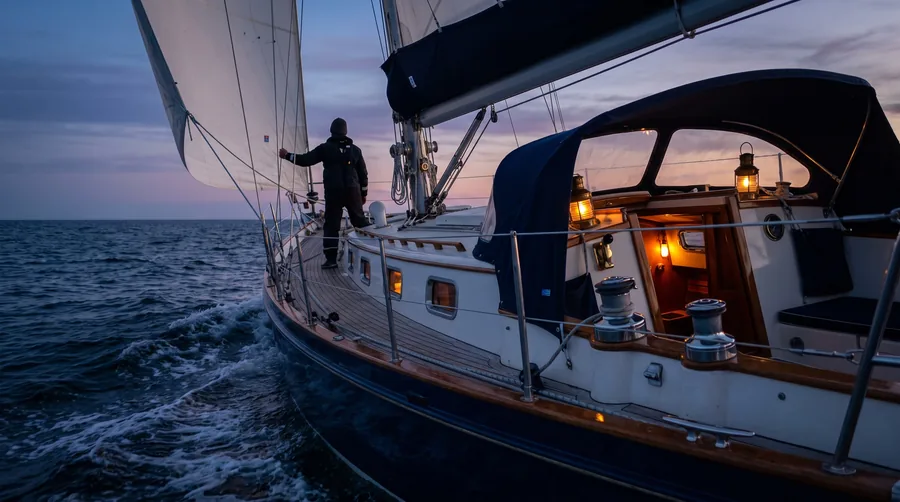
People who love sailing yachts are bad advocates for them, because they lead with the thing that cannot be argued: the moment the engine goes off and a four hundred tonne boat keeps moving at nine knots in silence. That moment is real and it converts nobody who has not felt it. So here is the case made in the other direction, starting with money and ending with the silence.
The running cost argument, which is real
A forty metre sailing yacht carries five to seven crew where a motor yacht of the same length carries eight to ten. She burns a tenth of the fuel on passage. Her berth costs the same, her insurance slightly less, her maintenance is different rather than cheaper. Across a year the gap is commonly thirty to forty per cent, and on a long passage it is an order of magnitude.
Annual running cost, 40 metre sailing yacht against a 40 metre motor yacht
The gap narrows if the sailing yacht is a carbon performance boat with a racing programme, and it widens on a boat that crosses oceans. An owner who plans to cross the Atlantic twice a year and spend the winter in the Caribbean will save more in fuel alone than the difference in purchase price amortised.
The inconvenient parts
She heels. Somewhere between ten and fifteen degrees the crockery moves, the guests who are not sailors go quiet, and the owner's partner starts looking at hotels. Good sailing yachts of this size are stiff and sail at modest angles, but a boat that never heels is a boat that is motoring.
She is slower to lunch. A motor yacht covers sixty miles in four hours whenever she likes. A sailing yacht covers it in six or seven when the wind is right and in four under engine when it is not, which raises the question of why the rig is there.
She carries fewer guests per metre, because the hull is narrower and a third of the volume is taken by the rig loads, the keel structure and the sail handling. A fifty metre sailing yacht and a forty metre motor yacht sleep about the same number of people.
And she needs a captain who can sail. That sounds obvious and it is the most common failure in the sector: a beautiful sailing yacht run by a captain whose experience is all in motor yachts, who therefore motors, and whose owner concludes after two seasons that sailing yachts are overrated.
The three kinds of sailing superyacht
The performance cruiser
Thirty to forty five metres, usually from a Northern European yard, carbon or aluminium, a deep lifting keel, a rig that can be raced and an interior that does not pretend otherwise. She sails well in eight knots of wind, which is the number that matters in the Mediterranean summer, and she can be taken to a regatta without embarrassment.
The classic and the neo-classic
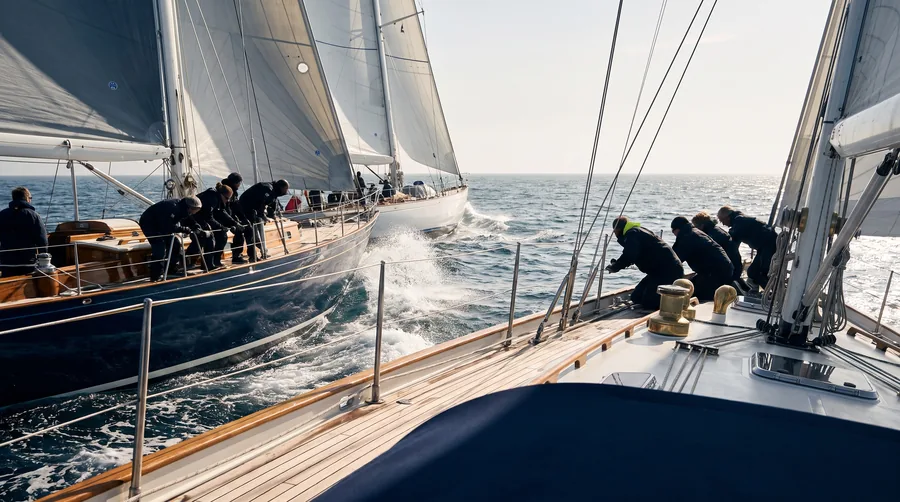
Long overhangs, low freeboard, a deck you photograph. The J-Class boats and their descendants exist to be beautiful and to race each other, and their owners are frank that the boat is a passion rather than a platform. Interiors are smaller than the length suggests and the maintenance is a craft rather than a schedule.
The big ketch
Above fifty metres the rig gets split, because a single mast tall enough becomes a structural and logistical problem and because two smaller rigs can be handled by a crew in a squall. These boats sail like motor yachts with an opinion: comfortable, capable, and requiring genuine seamanship the two days a year the weather turns.
The engine is a tool for getting into harbour. If you use it to get to lunch you have bought the wrong boat.
A sailing master, to an owner who had asked why they were still sailingWho should actually buy one
Owners who sail themselves, or who want to learn and will take the time. Families whose children are old enough to be useful and young enough to find the heel exciting. Anybody planning long passages. And owners for whom the point of the boat is the passage rather than the destination, which is a smaller group than the number of sailing yachts on the market suggests.
Everybody else should charter one for a week before they buy, in a place with reliable wind, with a captain who sails. Half of them come back converted. The other half have saved themselves a great deal of money and learned something about what they actually want.
Use it now
Sail or Motor
The same length, three hull types, one honest comparison.