Running costs
What a superyacht costs in a year nobody talks about
The purchase price is the part the buyer researches. The annual bill is the part that decides how long the boat stays in the family.
The old line is that a yacht costs ten per cent of her value every year. Like most old lines it is roughly right and useless in the particular. Ten per cent of what, in which year, with how many crew, lying where? The honest version is that a well run motor yacht of fifty metres costs between two and three and a half million euros a year, that the number is remarkably insensitive to how much you use her, and that the single largest line is people.
What follows is the anatomy of that bill, in the order the invoices arrive.
Crew, which is half of it
A fifty metre motor yacht carries ten to thirteen crew. Salaries run from about three thousand euros a month for a junior stewardess to twenty thousand or more for an experienced captain with a charter programme. On top of the salary sit flights home, medical insurance, training, uniforms, crew food and the payroll administration, which together add roughly a quarter again.
Rotation, where two people share one job in alternating months, has moved from engineers to captains to entire departments on the largest boats. It roughly doubles the cost of every position it covers, and owners pay it because the alternative is a new captain every eighteen months and a boat that never settles.
Where the annual bill goes on a well run 50 metre motor yacht
Maintenance, which never stops
A yacht is a building on a moving foundation in salt. Maintenance is not repair; it is the continuous work of preventing the sea from doing what the sea does. Teak decks are sanded and caulked. Stainless is polished and passivated. Paint is touched in. Filters, impellers, anodes, seals and belts are replaced on a schedule the chief engineer keeps in a book nobody else reads.
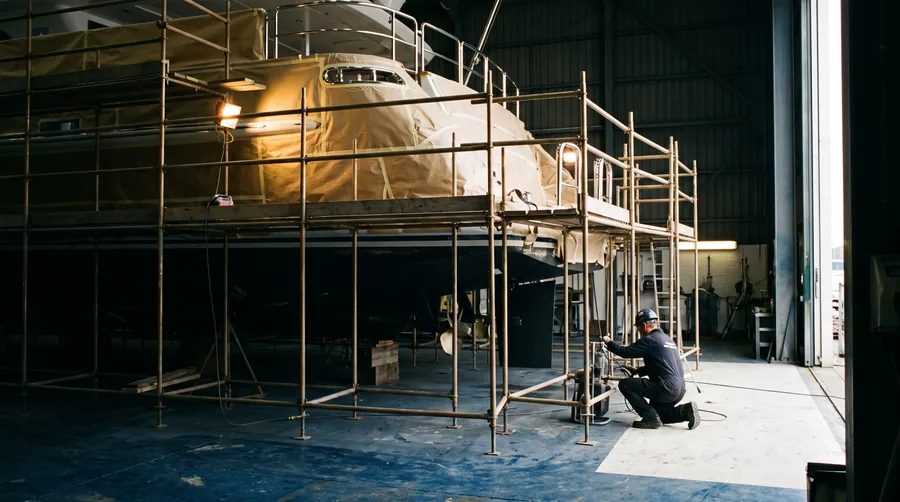
Then there are the periods that come whether the money is there or not. Class surveys every year, an intermediate at two and a half, and the big one at five with the boat out of the water. On a fifty metre yacht the five year event, once paint and teak are in it, rarely comes in under a million and a half and frequently reaches four.
Fuel, which is smaller than you think
Owners expect fuel to dominate and it rarely does, for the simple reason that a yacht barely moves. Ten to fifteen per cent of the year under way is normal. A fifty metre displacement yacht burns something like three hundred litres an hour at twelve knots, which is a large number on a crossing and a modest one across a season of short hops between anchorages.
What does cost money is the generator. A boat alongside in August with air conditioning running for twelve guests and thirteen crew burns fuel all day and all night, and shore power in a Mediterranean marina is metered at a rate that makes a hotel look philanthropic.
The reserve nobody sets aside
The mistake that ends more ownerships than any other is running the boat on a budget that has no line for the five year event. An owner who puts aside three hundred thousand a year from the first season meets the yard with a cheque. An owner who does not meets the yard with a decision about which half of the work to skip, and skipped work compounds.
The same applies to the tender, the toys, the electronics and the paint. None of them are emergencies. All of them arrive.
Use it now
Running Cost Model
What a yacht of a given length actually costs in a year, line by line.
What actually reduces it
Three things, none of them glamorous. A home berth in a working harbour rather than a famous one, which can halve the berth line. A captain who stays, which removes the hidden cost of a crew that turns over every season and a boat that is learned again each spring. And a maintenance schedule that is kept when the boat is not being used, because a yacht left alone for four months in the Mediterranean sun is not resting, she is ageing.
Chartering the boat is the fourth answer and it is a different conversation, because a boat that charters is no longer entirely yours. That argument has its own article.