The five year event
The refit year
Every five years the boat comes out of the water and is opened up. The invoice is the largest of the ownership, and it is entirely predictable.
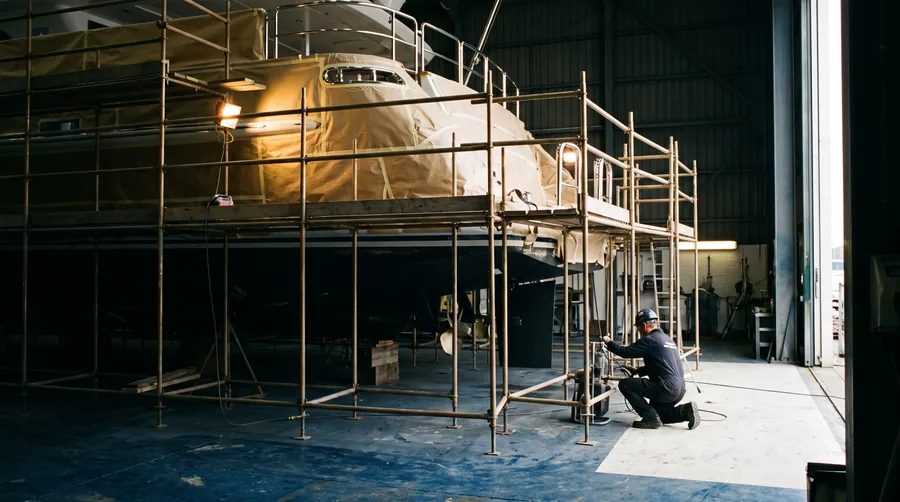
Ask a yard manager what goes wrong in a refit and they will not say the work. They will say the scope: an owner who arrives with a list of three items, and a boat that turns out, once the paint is stripped and the panels are off, to need eleven. The refit year is not a surprise. It is a budget line that was not opened in year one.
What forces it
Class. A yacht in class is surveyed annually, has an intermediate survey at two and a half years and a special survey at five, which requires her out of the water with tanks opened, shafts drawn, valves examined and structure inspected. Alongside that sit the manufacturer intervals: main engine overhauls by hours, generator rebuilds, stabiliser seals, water makers, and the air conditioning nobody thinks about until August.
Then the two items that dominate the invoice on any boat over fifteen years old: paint and teak. A full repaint of a fifty metre hull and superstructure in a covered shed is a seven figure job that takes three months and is ruined by one bad week of weather in an uncovered one. Teak is thickness: once the caulking seams are proud and the plank is under four millimetres, it is a replacement rather than a sand.
Running a refit that does not run away
Survey first, tender second
Have the boat surveyed and the scope written before you ask yards to quote. A specification that describes the work in detail produces comparable quotations; a conversation produces three numbers that cannot be compared and a variation order culture from day one.
Fix the daily rate and the variation process
Agree in the contract what an hour costs, what a variation order needs in writing before work starts, and who can sign one. Refits overrun through fifty small yes answers given on the deck, not through one big decision.
Put somebody on site
The captain, the chief engineer and a project manager who has done this before. A boat with no owner's representative on site is a boat whose schedule slips behind the yard's other work, politely and invisibly.
Where to do it
For fifty to ninety metres in Europe: the yards around La Ciotat, Marseille, Barcelona, Palma, Genoa and Viareggio, the Dutch and German builders for structural work on their own boats, and the Northern yards for major conversions. In the United States, Fort Lauderdale and Savannah. Choose by the trades actually on site and by the sheds available, not by the name on the gate, and visit two boats in the yard and talk to their engineers before you sign.
Use it now
Running Cost Model
What a yacht of a given length actually costs in a year, line by line.